
 Cloud Services
 Classified Cloud
 Managed Services
 Kubernetes
 Public Sector
 Defense & Space
 Homeland Security
 Healthcare
 Regulated Industries
 Critical Infrastructure
 Enterprise IT-Modernization
 SaaS & Digital Platforms
Cloud Services
Classified Cloud
Managed Services
Kubernetes
SaaS & Digital Platforms
Cloud Services
Classified Cloud
Managed Services
Kubernetes
Sovereign cloud infrastructure for the healthcare sector
In Everyday Clinical Practice
Digital Care Is Decided at the Bedside, Not in the Data Center
Whether a cloud strategy in healthcare is successful is evident in specific, recurring situations: connecting to the telematics infrastructure, networked devices, and the growing number of apps.
Clinical systems must be highly available while also meeting strict data protection and KRITIS requirements. secunet cloud securely migrates business-critical applications to the cloud without compromising security.

Connected medical devices generate and transmit sensitive data in real time. The underlying infrastructure must reliably secure this connection, from the edge to the cloud.
A new digital application is rapidly gaining users, and the infrastructure must be able to scale accordingly. Cloud and Kubernetes platforms scale along with the application without compromising security.

Regulatory Context
Requirements Applicable to the Healthcare Sector
Health data is classified as a specially protected category of data. GDPR Article 9 imposes stricter requirements on health data, while BSI C5 remains the compliance checklist for cloud providers. Hospitals exceeding certain case volumes, as well as many medical device manufacturers, are classified as important or particularly important entities under NIS2, with their own reporting and documentation obligations. For hospitals exceeding the KRITIS thresholds, § 75c SGB V regarding IT security in hospitals also applies. Connection to the telematics infrastructure requires gematik certification of the components used; medical devices and networked devices are subject to the MDR (Medical Device Regulation), while digital health applications are governed by the BfArM’s DiGA Regulation. secunet cloud covers this entire spectrum, from administrative applications to IT connectivity.
Sovereignty
Patient data deserves more than just a server location in Germany
Sovereignty in healthcare means: traceable code, no dependence on a single provider, and a planned path back, should it ever become necessary.
A transparent basis instead of a black box
No single provider on which everything depends
Runs on standard hardware without being tied to a specific manufacturer. Switching providers remains technically feasible.
Roleback planned, not improvised
A path back to our own infrastructure or to another provider is part of the operational concept. Especially when it comes to patient data, this must not be left open.
Even at the hospital's own data center
The same cloud stack runs on-premises, in the public cloud, or in a hybrid environment. The decision is made during setup, not by the provider.
Operations in Germany
If secunet takes over operations, this is done exclusively in certified data centers located in Germany.
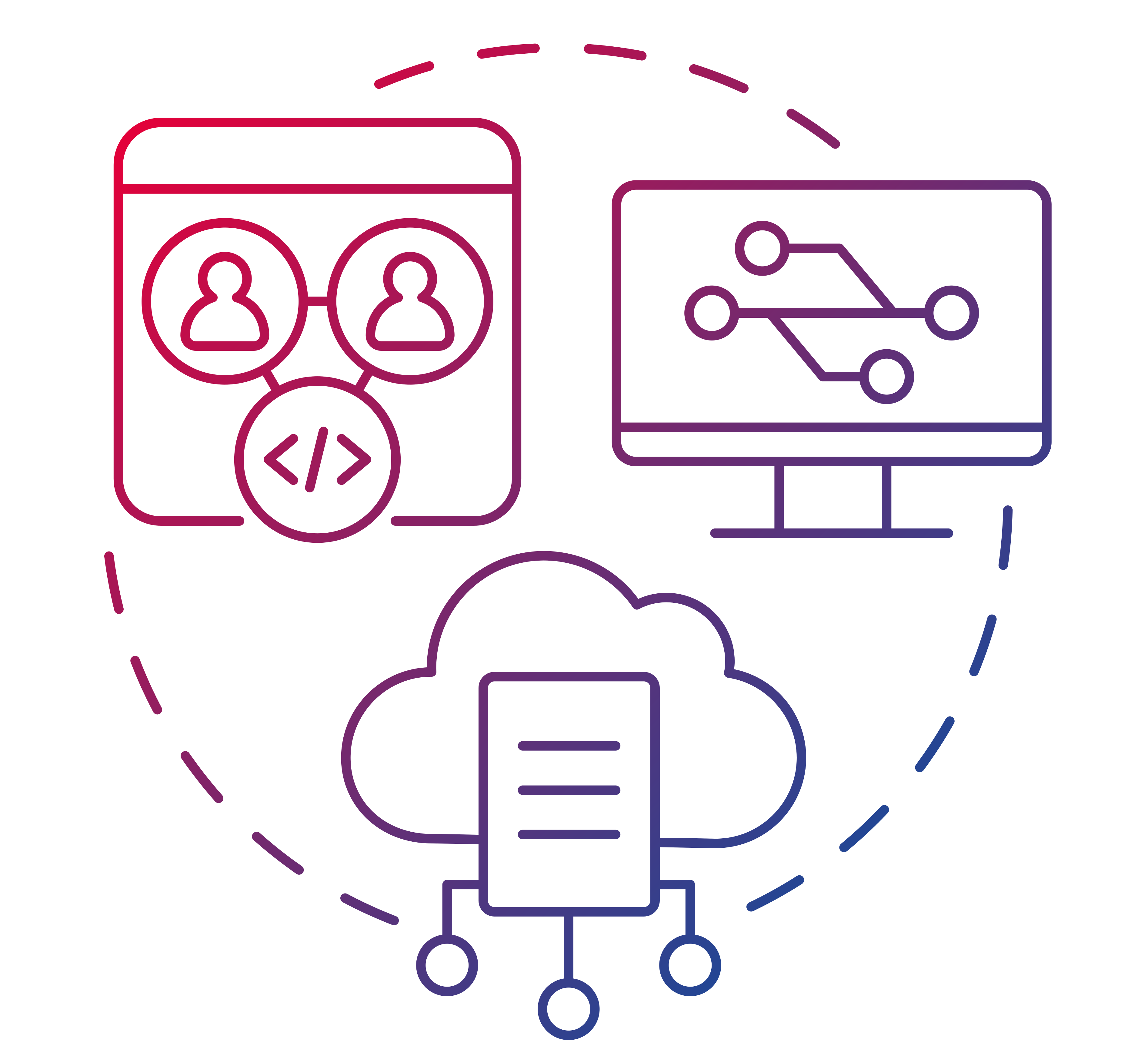
From scheduling appointments to AI-powered diagnostics: three operational stages

For patient portals, appointment scheduling, and administrative systems. Fully scalable with operations based in Germany.

A highly available platform for clinical and business-critical applications, with operational expertise rather than self-management.

A self-contained infrastructure for AI-powered diagnostics and analysis, without sharing patient data with external providers.
Zertifizierungen & Standards


Let’s discuss your project
Whether it’s digital applications or comprehensive infrastructures, together we’ll turn your requirements into a tailored solution.
